
Less math, better research: Generative Artificial Intelligence in the Ceramic Industry
Discovering a new glaze, tweaking a formula, studying a diagram or understanding why a simple variation in silica content can completely transform a glaze… All this takes time, a systematic approach and, often, a good deal of patience.
For decades, we have done calculations in our heads and using a calculator, just as Daniel de Montmollin has always done, following the method he sets out in his book “La pratique des émaux de grès.”: “Stoneware Glazes”. A magnificent, rigorous and deeply artisanal way of learning.
So, what does generative AI have to do with all this?
Most of us might think: “Yet another digital tool I don’t need”, or “Ceramics is about craftsmanship, not algorithms”, or even “I prefer to do my own calculations; it’s important to understand.”.
And yet.
When AI does not replace expertise, but rather supports our research into glazes — helping us to verify a formula, locate a point on a diagram, avoid a conversion error, or generate a complete series of alumina/silica variations in a matter of seconds — something interesting happens.
Not an ‘automation’ of our craft, but an enhancement:
➜ less time wasted on repetitive calculations,
➜ more time for research, observation, testing, firing, and critical evaluation.
This article is therefore not intended to convince you to use AI in place of your intuition or your practice, but simply to show you how a digital tool can become a genuine studio assistant: discreet, precise, and above all, at the service of your creativity.
In short: how can AI help you explore a glaze…
without ever taking away the pleasure of discovering it in the kiln?
-
Stay in control of the process
First and foremost, you need to be clear about what AI cannot do — and probably never will be able to do. It cannot assess a glaze as it comes out of the kiln. It cannot perceive the depth of a celadon, the way a surface catches the light at an angle, or the tension in a glaze that has nearly bubbled. It doesn’t know your kiln, your firing habits, the way your clay reacts to firing, or the fact that you’ve been using feldspar from a particular quarry for twenty years.
What AI can do, however, is work upstream: calculate tirelessly, organize batches without losing track, check for standardization, and rephrase a technical question in clear language. It is in this space — that of preparation and reflection — that it becomes truly useful.
The basic rule is simple: you decide the direction. The AI calculates and organizes. You observe, interpret, choose. This division of roles, if managed well, is what makes the tool truly valuable — without ever taking away your craft.
-
Checking a formula, avoiding hidden errors
In the Seger method, a small error can go unnoticed for hours and skew an entire series of tests. A sum of fluxes that does not add up to exactly 1.00. An Al₂O₃ coefficient calculated using a molar mass that has been rounded off too early. A potassium feldspar treated as if it were sodium feldspar. These errors are insidious: they do not set off any alarms, and are only discovered when the results fail to make any sense.
Here, AI acts as a second pair of attentive eyes. We feed it a Seger formula, ask it to check the normalisation, recalculate the Al₂O₃/SiO₂ ratios, and flag anything that seems inconsistent. It doesn’t judge the aesthetic quality of the glaze — but it’s very reliable with figures, provided you give it the right instructions: the exact molar mass of the raw materials, the chosen normalisation method (RO=1), and the order of priority for the raw materials.
A typical example of a verification prompt: “Here’s my Seger formula. Can you check it and let me know if anything seems wrong?” Within seconds, the AI returns a summary table, often with a note if it detects an anomaly. It’s not infallible—you should always check for yourself—but it’s a safety net that saves a lot of frustration.
-
Saving time on repetitive calculations
Creating a series of Al₂O₃/SiO₂ variations by hand is tedious. For each point in the diagram, you have to recalculate the proportions of each raw material, check the totals, make adjustments if any value goes into negative territory, and then neatly transcribe the whole thing. Over ten points this amounts to hours of meticulous work — during which a single lapse in concentration is enough to throw everything off.
AI completes this task in a matter of seconds. We give it a basic formula, the constraints (fixed fluxes, fixed Al₂O₃, SiO₂ variable from 1.5 to 5 in 0.5 increments, recipes based on 100 g, feldspar as a priority), and it returns a complete, readable table that simply needs to be checked and transferred to the test sheets.
This time saving is no luxury. It is time reclaimed for what really matters: observing, comparing the test plates, noting the effects, and deciding on the next batch. The calculation becomes a formality, and reflection regains the prominence it deserves.
-
Exploring a diagram more freely
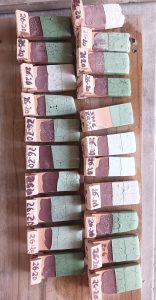
The diagrams provided by Daniel de Montmollin, featuring Al₂O₃/SiO₂ progressions, are powerful tools, but they require a genuine effort to master. Locating a point, understanding which zone you are in (matt, satin, glossy, underfired glazes), anticipating the effect of a shift — all this requires a thorough understanding of the axes, proportions and characteristic zones.
AI allows you to explore these diagrams more flexibly, especially when you’re just starting out or looking to expand an area you’re already familiar with. You can ask : “I’m at Al₂O₃ = 0.40 and SiO₂ = 3.5 on ‘such-and-such a diagram’ (they’re numbered) taken from Daniel de Montmollin’s book “La pratique des émaux de grès.” “Towards which firing zone will I move if I increase the alumina to 0.50 whilst keeping the silica constant?” The AI reasons on the basis of its general knowledge of glaze chemistry and provides a guided response, to be taken as a working hypothesis — not as an absolute certainty.
This method of exploration through questions and answers is particularly useful when you want to mentally test several directions before deciding which trials to prepare. You substitute an oxide, compare two points on the diagram, refine your hypotheses — without firing anything yet, without spending anything, just by thinking aloud with a conversation partner who knows the chemistry of silicates.
-
Moving from formula to recipe
Translating a Seger formula into a recipe using specific raw materials is often where things get complicated. You have your formula, you know the target range — but moving from the diagram to the scales requires knowing the exact composition of each raw material, using them in the correct order and managing practical constraints: no material below a certain threshold, no combination that would cause a melting anomaly.
AI handles this conversion work with remarkable precision, provided it is given the correct parameters: what molar mass for the alumina, what composition for the feldspar used, what method (feldspar as a priority, or dolomite, or other), recipe based on 100 g or another basis. It then returns a recipe with the gram quantities that simply need to be weighed.
This transition from theory to practice — from the figures in the formula to the grams on the scales — is often where time is wasted and mistakes are made. AI does not eliminate the need to understand what one is doing, but it significantly speeds up the process, especially when one wishes to test several recipes in the same working session.
-
Gaining a better understanding of materials
The chemistry of glazes is based on a vocabulary and a logic that can be confusing at first. Why do calcium carbonate and wollastonite both contribute CaO, yet do not behave in exactly the same way during firing? What is the difference between an alkaline flux and an alkaline-earth flux, and why does this affect the surface of a glaze? How does silica compete with alumina to structure the glass network?
AI is particularly well-suited to this type of educational question. It can explain the difference between two materials, clarify the role of an oxide in the formula, or help understand why a partial substitution of kaolin with calcined alumina will alter the raw firing behaviour of the glaze. These explanations can help advance understanding of a problem, reformulate a question, or verify that a principle has been properly grasped before relying on it during firing.
It is also useful for avoiding classic substitution errors: using dolomite in the belief that it only contributes MgO (it also contributes CaO), or confusing two feldspars whose compositions are similar but not identical. A well-asked question can often prevent a disappointing firing.
-
Testing hypotheses without firing everything
Firing takes time, energy, and often significant logistical planning. You don’t fire up the kiln for a dubious experiment. The question “Is it worth testing this?” is therefore often decisive.
AI allows us to reason through this question before committing. If we describe a formula to it and ask it to predict likely behaviour — risk of bubbling, tendency to run, possible opacification with the addition of a particular oxide — it can formulate a reasoned hypothesis, drawing on the general chemistry of glazes. It is not a guaranteed prediction, and it does not know your kiln — but it is an informed opinion that helps decide whether the trial is worth running, or whether it is better to adjust the formula first.
You can also submit two alternative formulas and ask which one seems more consistent with the desired effect. This dialogue, however imperfect, disciplines the mind: it forces you to clearly articulate what you are seeking, to name the expected effects, and to justify your choices. And often, it is in this process of formulation that the right idea emerges — regardless of the AI’s response.
-
The limitations of AI — and why they matter
AI can make mistakes, and sometimes with remarkable confidence. It might invent a feldspar composition, confuse two oxides with similar roles, or give an answer that seems perfectly logical but is based on a false premise. These errors are not always easy to spot, especially when you are still learning.
There are also factors it simply cannot know: the actual composition of your raw materials (which can vary from batch to batch), the characteristics of your firing’s heatwork and temperature curve, the firing atmosphere, the application thickness, and the texture of your clay body. All these factors profoundly influence the final result and are invisible to the AI without a precise description in prompts that need to be fleshed out as you use AI. The right approach is that of a practitioner consulting a competent but external technician: you listen, you take on board what seems right, you check the critical points, but you always have the final say. AI is a tool, not an authority. It can speed up the thought process — provided you never delegate judgement to it.
-
Practical example: creating a series of glazes step by step
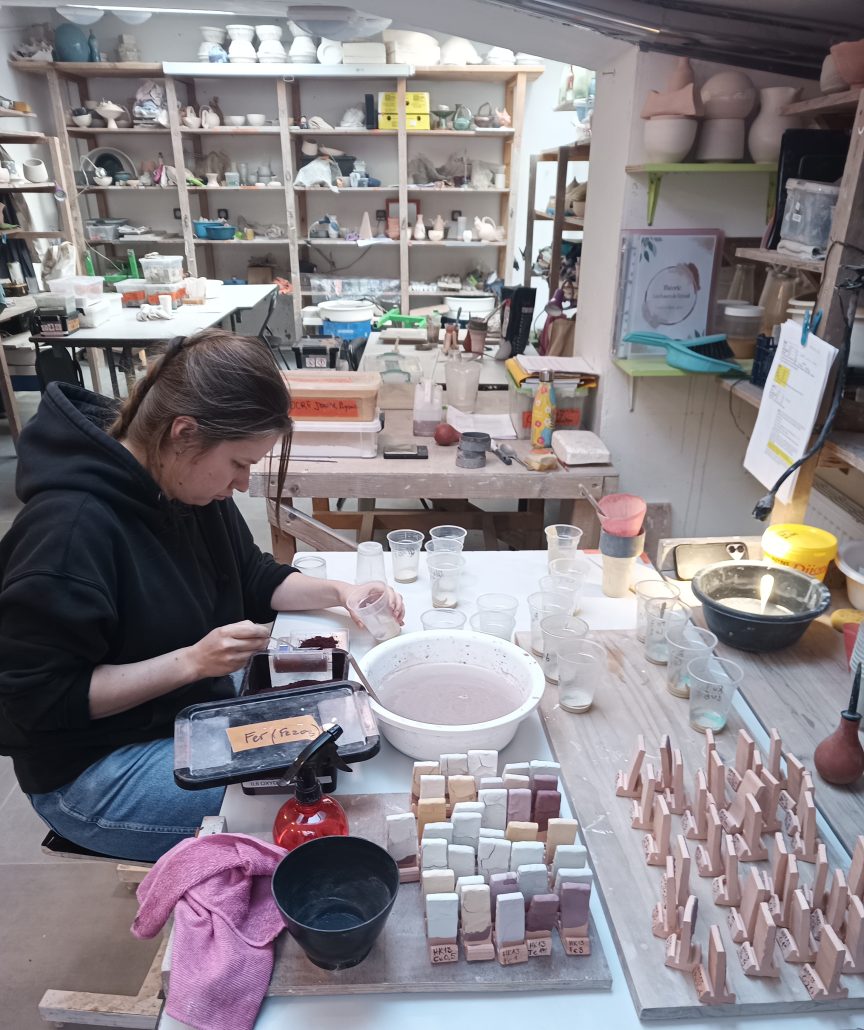
Here is a practical example of a working session with AI in the studio. The starting point: a basic formula to explore, a range of silica content to test, and a desire to compare the effect of this gradient on a high-temperature stoneware.
First message sent to the AI:
I am working with high-temperature stoneware using the method described by Daniel de Montmollin in his book “*La pratique des émaux de grès.”*.
I want to make a series using: 0.23 KNaO – 0.55 CaO – 0.21 MgO – 0.40 Al₂O₃.
The silica content varies from 1.5 to 5 in 0.5 increments.
Can you prepare the recipes for me based on 100 g?
Start with the potassium feldspar; be careful not to round off the figures too early.
Within seconds, the AI generates a table of recipes, with the gram quantities for each raw material. We quickly check the extremes — SiO₂ = 1.5 and SiO₂ = 5 — ensure the totals are correct, and prepare the weightings.
After firing, we return with our observations: “The recipes with SiO₂ between 2.5 and 3.5 are the most interesting. The surface at 3.0 is very satiny, almost milky. Can I accentuate this effect by slightly increasing the MgO?”
And so it continues: the series generates observations, the observations generate new questions, the questions generate new series. The AI is present at every stage of the calculation, but it is the observation upon removal from the kiln that remains the true driving force behind the research.
Which AI tools should you use — and where should you start?
No need to subscribe, no need to install anything. The leading generative AI tools are accessible for free via a web browser. Here is an overview of the tools available, ranging from the most useful to the more niche options.
The three must-haves:
Claude (claude.ai) — Often seen as more attentive to precision and nuance. It handles detailed calculations and structured queries well. Particularly adept at providing educational explanations.
Gemini (gemini.google.com) — Google’s AI. Accessible with an existing Google account, so it’s already within reach for many. ChatGPT (openai.com) — The best known and best documented. The free version (GPT-4o) is more than sufficient for working on Seger formulas, generating recipe series or asking questions about glaze chemistry. A good starting point. Performance comparable to the previous two.
Some other options, with an honest opinion:
Microsoft Copilot (copilot.microsoft.com) — Integrated into Windows and the Office suite. Useful if you work in Excel on recipe tables. Outside this context, it offers no particular advantage over ChatGPT.
Perplexity (perplexity.ai) — Its strength lies in research: it cites its sources and links to web pages. Very useful for finding information on a raw material, an oxide, or a supplier. Less suitable for formula calculations.
DeepSeek (chat.deepseek.com) — A Chinese model with impressive technical capabilities, available free of charge. It is perfectly suitable for calculating glazes. It should be noted, however, that its terms of use are less transparent than those of Western tools, which calls for caution regarding the data submitted to it.
Grok (x.ai) — The AI developed by Elon Musk, integrated into the social network X. Its performance is decent, but it offers no specific advantage for our purposes and requires an account on the X platform (formerly Twitter).
Mistral / Le Chat (chat.mistral.ai) — A French model, developed by a European company, subject to the regulatory framework of the European Union. For those concerned about data sovereignty, it is a credible alternative to American tools. Performance is good on technical questions.
Which one should you choose? To start with: Claude, without a doubt. For research into specific subjects: Perplexity as a complement. For those particularly concerned about data privacy: Le Chat de Mistral is worth a try.
What if you make a mistake? There’s nothing to worry about.
You type in a text box, read the reply, and ask another question. That’s all.
⚠️ A precaution to bear in mind. Conversations with these tools may be used to improve the models, in accordance with each service’s terms and conditions. When searching for glazes, this is generally not a problem. However, it is best to avoid pasting in contact details, customer information, or any content you would not want to see circulating outside the workshop. Treat these tools as you would a public forum — share only what you would share with any knowledgeable stranger. For US-based tools, data is hosted in the United States; Mistral is an exception, with European hosting.
Conclusion
AI cannot replace expertise. It cannot replace the intuition gained through countless firings, nor the eye that can read a surface, nor the hand that recognizes the right consistency of a glaze. Nor can it replace the pleasure of opening the kiln.
But it does allow us to spend less time on calculations, less time doubting a figure, less time restarting a batch because of a standardization error. And so more time examining what comes out of the kiln, understanding why, and deciding what to do next.
Perhaps that is its greatest quality: not to speed up the work, but to refocus it on what really matters — observation, curiosity, and the pleasure of exploration.
Resource centre
animated by Matthieu Liévois,
potter-ceramist for over 40 years and founder of the Creamik School
Find all the courses
Keywords
Don’t miss any more news from the Créamik school!
Follow us on the networks
You can also discover…

Garance Lanfray, journey through Southeast Asia
From beginner to professional : choosing the right ceramic courses

Matthieu Liévois, The search for crystals
Can ceramics be fired in a microwave?
Discovering the Art of Japanese Ceramic Masters
Instructions for making your own sieve

Key books on ceramics by Matthieu Liévois